Which Colosseum tour actually goes deeper — and which just costs more
Updated September 17, 2026 · 8 min read
If you already know roughly what happened in the Colosseum, the standard tour is a strange experience. You have paid for two and a half hours, of which seventy-five minutes are inside the building, shared with up to twenty-five other people, and the commentary has to work for someone who has never heard of Vespasian. It is well made and it is not for you.
The question then is what “more” is actually available, because the listings use the same three words — exclusive, premium, VIP — for four completely different things.
Depth is a place, not an adjective
Everything that genuinely adds substance is a physical area you either can or cannot enter. There are three inside the monument, and they are what you should be reading listings for.
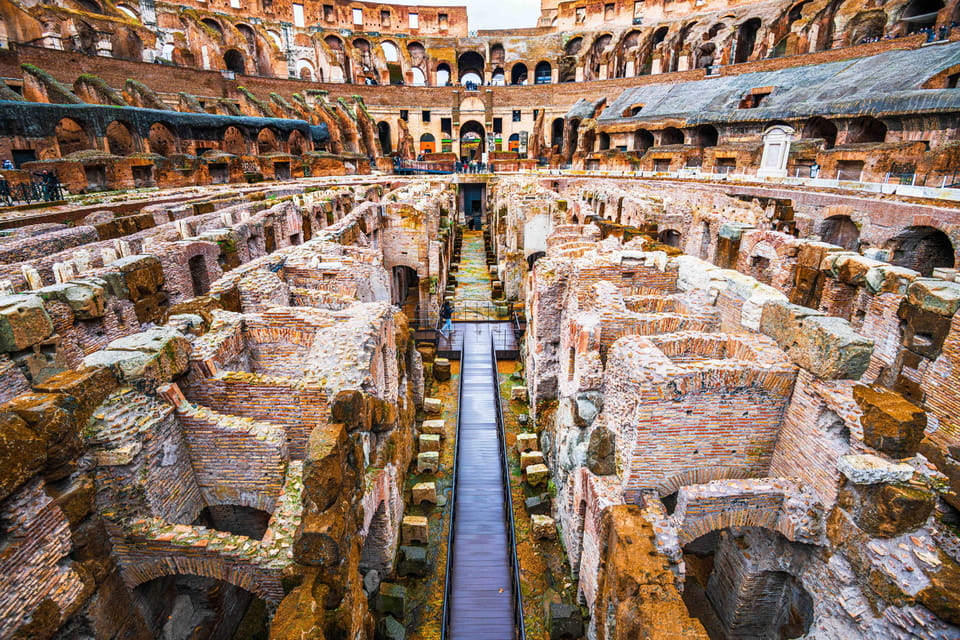
The underground. The hypogeum is the two-storey brick labyrinth below the arena: the animal cages, the corridors, the shafts for the lifts that raised scenery and beasts to the floor above. It is the part of the building that explains how the spectacles were actually staged, and it is the one thing that changes how the rest of the Colosseum reads. Access is in guided groups of at most twenty-five, admitted every fifteen minutes, and the park’s own ticket adds it “subject to availability” — meaning the constraint is capacity, not money.
The attic. A panoramic lift takes you to the intermediate gallery, which is step-free along its whole length; the attic itself, the highest level the public can reach, is up steep stairs from there. Almost nobody books it. It has its own Full Experience ticket, separate from the arena and underground one, and it is the only way to see the oval from above rather than across.
The SUPER sites. This is the part most people leave on the table. The €24 Full Experience tickets include a set of enclosed sites on the Palatine and in the Forum that the €18 ticket does not: the House of Augustus and the House of Livia with their painted walls, the Domus Tiberiana, Santa Maria Antiqua, the Curia Iulia, the Temple of Romulus. They have their own opening rotations and small capacities, and they are where you stop sharing the site with a tour group every forty seconds. For six euros, this is the least-argued-about upgrade in Rome.
The park runs its own guided visit
Worth knowing because it is buried: alongside the plain €24 Full Experience Underground and Arena ticket, the archaeological park sells the same ticket with an educational tour for €32. The guide is the park’s own, the route is theirs, and the eight euros is the whole difference.
That is not a recommendation over a platform tour — the language, the times and the availability are all narrower, and it is booked through the park’s own system rather than anywhere convenient. But if you are comparing a €106 listing against “the official one”, the official one exists and costs €32, and that is a useful anchor for what you are being asked to pay for elsewhere.
What the money actually buys above €24
In our Colosseum selection, the deeper end runs like this: around €95 for a guided tour with the underground as an option, €99 for one offering arena floor or underground, €106.40 for a version rated 4.6 across 1,545 reviews, €169 and €199 for longer combinations, and €475 to €499 for private tours.
Two honest observations about that ladder. Between €24 and roughly €110, you are buying access plus a guide plus a smaller group, and that is a real product. Above it, you are almost entirely buying exclusivity — fewer people, your own start time, a guide who answers only your questions. Whether that is worth three hundred euros is a question about you, not about the building.
And watch the word or. Several listings in that range make you choose between the arena floor and the underground at the moment of booking, and the title does not always say which you are getting. If you want both, the listing has to say both.
The arena floor is not depth
It is the most-sold upgrade and the one most often mistaken for a deeper tour. Standing on the reconstructed floor is a sensation, not an explanation — the tiers rise around you and that is the whole of it. Nothing about the arena tier tells you anything the upper tier does not, and the view of the exposed hypogeum that everyone actually pictures is the one from above. Which tier includes what, and what “optional arena” really means, is set out separately.
Two things beyond the fence
The Domus Aurea. Nero’s buried palace, a few hundred metres uphill, is open Friday to Sunday only, with escorted visits every fifteen minutes and no entry without an advance reservation. The version with an educational tour and a virtual-reality reconstruction costs €26. For anyone interested in what Rome was like before the Colosseum was built on the drained lake of Nero’s estate, this is the missing half of the story — and it is a restoration site, so it is cold, damp and unfinished-looking in a way that is part of the point.
The Ludus Magnus. The gladiators’ training barracks, built under Domitian with its own miniature practice arena, lies sunken between Via Labicana and Via di San Giovanni in Laterano, two minutes’ walk from the Colosseum. It was linked to the amphitheatre by an underground passage. There is no ticket and no gate: because the site sits below street level you can walk all four sides of it and see the whole thing from the railing. Most guided routes do not go there, and it takes five minutes.
Reading a listing for substance
Four things tell you more than the price does. Group size, stated as a number — twenty-five including the guide is the ceiling set by the park’s visitor regulation, so “small group, maximum 12” is a genuine distinction and an unstated group size usually means the ceiling. Named areas, not adjectives: a listing that says “hypogeum” and “third tier” is describing a route; one that says “exclusive access” is describing nothing. Duration against inclusions — three hours covering the Colosseum, Forum and Palatine is not a deep tour, it is a normal tour with a long walk. And the guide: guiding inside the park is restricted by Italian law to licensed professional guides, so the relevant question is not whether the guide is qualified but how many people are listening.
For the layers of the city that have nothing to do with the amphitheatre — the catacombs, San Clemente’s stacked churches, the Case Romane — the underground category is the better starting point, and the walking tours cover the ancient street level above them. If you are still fitting the Colosseum into a short stay, the days-and-priorities overview does that arithmetic.