The Colosseum with children: the free ticket you still have to book
Updated September 17, 2026 · 8 min read
Start with the thing that goes wrong at the gate, because it goes wrong often and it is entirely avoidable.
Admission to Italian state museums and archaeological sites is free for everyone under 18, and the Colosseum is one of them. That does not mean you can turn up with a child and walk in. The free ticket is still a ticket: it has to be reserved in advance through the official system, in the child’s name, and it cannot be picked up at the ticket office on the day. A family of four books four tickets — two at €18 and two at €0 — and all four are checked against a document at the entrance.
Parents who booked only the paying adults are the ones standing outside. It costs nothing to prevent and nothing can be done about it once you are there.
Two further rules from the same source: visitors under 12 must be accompanied, and the name on each ticket can be corrected only once, up to midnight seven days before the visit. Book under the names of the people who will actually be standing there.
The 75-minute cap is a feature
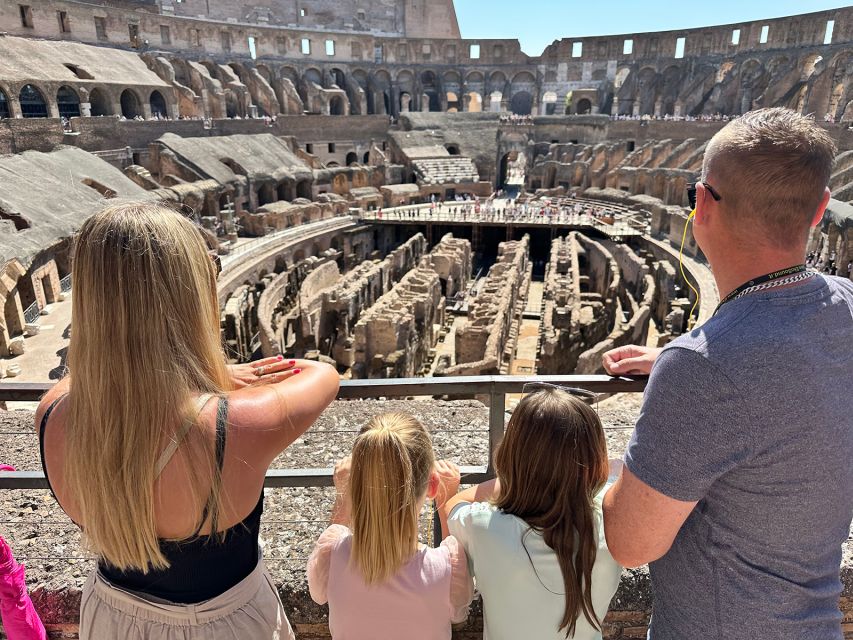
The €18 ticket allows you 75 minutes inside the Colosseum. The €24 Full Experience tickets allow 90. For most other visitors this is a constraint. With children it is the single most useful number on this page, because it tells you the building is a contained commitment — roughly the length of a film, with a hard end you did not have to negotiate.
The problem is never the Colosseum. It is what comes after it. Every standard guided tour bundles the Roman Forum and the Palatine Hill and runs two and a half to three hours in total, and the Forum is where it falls apart: an enormous open site of broken stone, in the sun, after your child has already concentrated for an hour. The amphitheatre looks like something. The Forum requires you to imagine what is missing, which is a skill that arrives somewhere around eleven.
If you have two mornings, use the ticket’s 24-hour window and do them separately — the Forum entry is not tied to a time slot, and that flexibility is worth more with children than any upgrade you can buy.
The formats, honestly compared
Ticket plus audio guide, from about €18 to €25. You go at your own speed and you leave when it stops working. No group to hold up, no guide to be embarrassed in front of, no schedule. For a first visit with a child under about eight this is often the best thing available, and it is also the cheapest. The trade is that you supply the enthusiasm.
A tour built for children. In our Colosseum selection there are several, and they are genuinely different products rather than the standard tour with a friendlier voice: a gladiator narrative that follows one named fighter, at €54.75 with 4.2 stars across 270 reviews; a treasure-hunt format at €109.25, rated 4.6; another kids’ gladiator tour at €110 with 4.1; and a small-group family tour built around games and activities at €220, rated 4.8 across 347 reviews — the most-reviewed of the family-specific listings. A private family version runs €229.
Check whether the price is per person or per party before you compare any of those. The spread from €54.75 to €299 is mostly the difference between a shared tour priced per head and a private one priced for the whole group, and for a family of four the cheaper-looking number is not always the cheaper booking. It is stated on the booking page; it is not always obvious from the title.
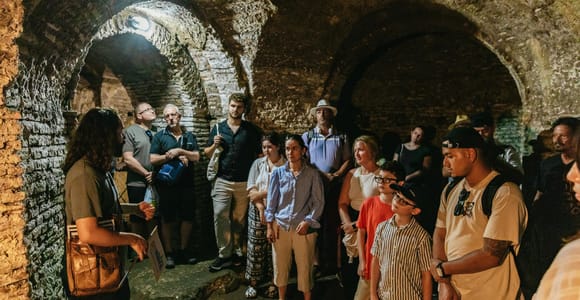
A standard adult tour. Workable for older children, and one detail makes it much more so: any guided group of nine or more people including the guide must use radio headsets, and the maximum group size inside the monument is 25 including the guide. A child with a headset can drift two metres away and still hear. In a group of 25 without one, they hear nothing and stop trying.
What to leave out
The underground. It is the best part of the Colosseum for an adult with an interest in how the spectacles worked, and it is not automatically a good idea with children. Operators describe the route themselves as stairs, narrow corridors and uneven ground in low light. Some children find that thrilling and some find it frightening, and you know which you have. If you want it, ask the operator directly what the route involves before booking rather than at the entrance — it is entered in timed guided groups and there is no stepping out halfway.
The free first Sunday of the month. Free sounds like the obvious family choice. In practice the timed-entry system is the thing that makes the Colosseum bearable, and on free days you are giving it up in exchange for the largest crowd of the month. With a pushchair it is a bad trade.
Minimum ages
There is no single age limit for Colosseum tours. Operators set their own, they differ between a family tour and an underground tour on the same day, and the only reliable place the number appears is the booking page of the specific listing. Anyone quoting you one figure for “Colosseum tours” is guessing. Check it before you pay, especially for the underground and for anything described as a small group.
The practical half-hour
- Bags. A day bag or changing bag is fine. Suitcases and large backpacks are not, and there is no left-luggage facility at the monument — if you are visiting between hotels, deal with the bags first.
- Water. Rome’s street fountains, the nasoni, run cold and drinkable all over the city and there are several around the Colosseum, though not on the route inside. Refillable bottles are allowed. Bring one full.
- Toilets and changing. On the first tier, including accessible cubicles with baby-changing.
- Pushchairs. Fine at ground level. The upper tier means folding it and carrying it, and there is nowhere to leave it. With a baby, a carrier is the easier answer.
- Time of day. The Colosseum opens at 8.30 a.m. and the first slot is the calmest hour of the day. In summer the alternative is late: last admission is 6.15 p.m. until 30 September, and the light at that hour is better than at any other. From 25 October the last admission drops to 3.30 p.m., which quietly removes the afternoon option altogether.
If Rome with children extends beyond ancient stones, a pasta or gelato class is the reliable second day — children who will not look at a temple will happily make dinner — and the wider list of things to do covers the parks and viewpoints. For fitting all of it into the days you have, the priorities overview does the arithmetic, and the choice between a handset and a human is set out here.