Making sense of ancient Rome: the rooms your €18 ticket does not open
Updated September 17, 2026 · 8 min read
People leave the Roman Forum disappointed more often than they leave the Colosseum disappointed, and the reason is not the ruins. It is that the standard ticket walks you past almost every building in which ancient Rome is still legible, and nothing at the gate tells you so.
The Colosseum is a shape you already know. The Forum and the Palatine are forty hectares of foundations, and what makes them readable are the handful of interiors that survived with their walls and their paint: a senate house still standing to full height, a church built inside a Roman hall, two houses on the hill with frescoes on the plaster. Whether you get into those depends entirely on which of two identically priced tickets you bought.
Two tickets, same price, different city
The park sells both at €18 full fare, both reduced to €2 for EU citizens from 18 until the day of their 25th birthday.
Colosseum, Roman Forum and Palatine. Valid 24 hours. The park’s own “includes” list has seven lines: the first level of the Colosseum, the second level with its panoramic terraces, the Colosseum Museum, the Roman Forum, the Roman Forum Museum, the Palatine, and current exhibitions. It is the ticket almost everyone buys, and it is a Colosseum ticket with a large outdoor walk attached.
Forum Pass SUPER. No Colosseum at all. In exchange it opens the Imperial Fora and what the park calls the SUPER sites, and that list is where the substance is:
- the Curia Iulia, the senate house, standing to its roof — with its own opening days, see below
- Santa Maria Antiqua, a sixth-century church inside an imperial hall, with layers of painting on the walls
- the House of Augustus and the House of Livia on the Palatine, the frescoed rooms of the first emperor’s household
- the Temple of Romulus, the Domus Tiberiana exhibition rooms, the Aula Isiaca and Loggia Mattei, the Horrea Piperataria
- the Palatine Museum, lower floor only
Same eighteen euros. One of them is the outside of ancient Rome; the other is the inside.
The ticket that ends the argument
There is a third option, and once you have seen the two lists above it stops looking like an upgrade and starts looking like the sensible default.
Full Experience Underground and Arena, €24. Valid two consecutive days. It carries the Colosseum with the arena floor and the underground, ninety minutes inside instead of seventy-five, and the full SUPER list — Curia, Santa Maria Antiqua, both houses, the Palatine Museum, the lot. Last admission for this ticket is 5.20 p.m.
Six euros over the standard ticket buys the arena, the hypogeum, an extra fifteen minutes in the building, every interior on the hill, and a second day to use them in. There is also a Full Experience Attic ticket at the same structure, which trades the underground for the intermediate gallery, the third level, the attic and the panoramic lift.
The arena floor is what these tickets are marketed on, and it is the least of what they contain. If the arena is the only part you want, the arena access comparison covers the cheaper routes to it.
Three opening times, thirty minutes apart
The park does not open as one place, and the staircase decides the shape of your morning:
- Colosseum: 8.30 a.m.
- Roman Forum and Palatine: 9.00 a.m.
- SUPER sites: 9.30 a.m., and they close one hour before the park does
That last line is the one that catches people, because it is not published on the gate you walk through. The painted rooms open half an hour after the archaeological area and shut an hour early. A late-afternoon Forum visit in winter — when the last admission is 3.30 p.m. and the park closes at 4.30 — reaches the SUPER sites as they are being locked.
So the ancient-Rome day builds from the top down. Colosseum at 8.30 when it opens and the light is low in the arcades. Forum from 9.00. Interiors from 9.30, while you are still fresh enough to look at plaster.
The weekdays that close individual rooms
The House of Augustus is closed on Mondays. The House of Livia is closed on Tuesdays.
The park states both, on every ticket page that includes them. They are the two best-preserved interiors on the Palatine and they are shut on adjacent days, which means a Monday-to-Tuesday city break with one Palatine morning misses one of them whichever day you choose. Wednesday to Friday are the safest days for the hill.
The Curia Iulia works the other way round, and that is why no single route fits every day: it is not open daily. The park has changed its days and hours several times in recent years — at times Saturday and Sunday only, at times Saturday to Monday, with its own last admission in the early afternoon — and it announces changes and short-notice closures individually on its notice pages. If the senate house is the reason you are going, check its day before you plan the rest; a Palatine Wednesday and the Curia may not fit into the same morning.
Also worth knowing before you go looking: the Domus Transitoria is not continuously accessible — whether it opens on your date is likewise on the park’s notice pages. And the Domus Aurea is a separate site with separate tickets, open Fridays, Saturdays and Sundays, with visits every fifteen minutes between 9.00 a.m. and 4.30 p.m., closed on the first Sunday of each month. It is Nero’s palace and it is not in the park’s main ticket at all.
Where to walk in, and the door nobody uses
There are five ways into the Roman Forum and Palatine area: the Arch of Titus entrance, Largo della Salara Vecchia, the passage of Via del Tulliano, via del Foro Romano and via di San Gregorio. They are not interchangeable. The Arch of Titus door puts you at the Colosseum end and lets you walk the Via Sacra in the direction the ancient processions took. Via di San Gregorio delivers you to the foot of the Palatine, which is the one to use on a hot afternoon when you want the hill before the open Forum floor.
The Forum Pass has an advantage the standard ticket does not. Its route runs barrier-free from the Imperial Fora: across part of the Forum of Trajan, under Via dei Fori Imperiali through the cellars of the old Alessandrino quarter, the length of the Forum of Caesar, past the Forum of Nerva, and into the Roman Forum at the Curia. The passage between the two areas is open daily from 9.00 a.m. to 6.00 p.m. For anyone who cannot manage the Palatine’s slopes, that is the most of ancient Rome available on level ground.
The Forum Pass also needs no time slot — bought online it can be used within 30 days, and once validated it is good for that day only. That is a different kind of booking from the Colosseum’s fixed-minute entry, and it cannot be used at all on the free first Sunday of the month.
A route that makes the ruins legible
If you want the place to explain itself rather than to be photographed, go in this order.
The Curia first, if it is open on your day. It is the only major Forum building you can stand inside as a room, and once you have a sense of scale from an intact interior, the foundations outside stop being rubble and start being floor plans. On a day without the Curia, Santa Maria Antiqua takes that role — worse for scale, better for colour.
Then the Via Sacra, uphill. Arch of Titus, the Temple of Venus and Rome, down past the Basilica of Maxentius. This is the axis everything else hangs off.
Then Santa Maria Antiqua. A Roman hall that became a church and kept the paintings. It is the single clearest demonstration in the city of what happened to ancient Rome after ancient Rome — which is the question most visitors actually have and almost nobody asks out loud.
Then up to the Palatine, the houses, the museum, and the terrace over the Circus Maximus at the end, when your legs are done and you want to sit.
The Colosseum fits at either end of that, because the standard ticket lets you use the Forum entry any time within 24 hours either side of your Colosseum slot — the mechanics of splitting it are in one tour or two mornings.
Whether to take a guide for it
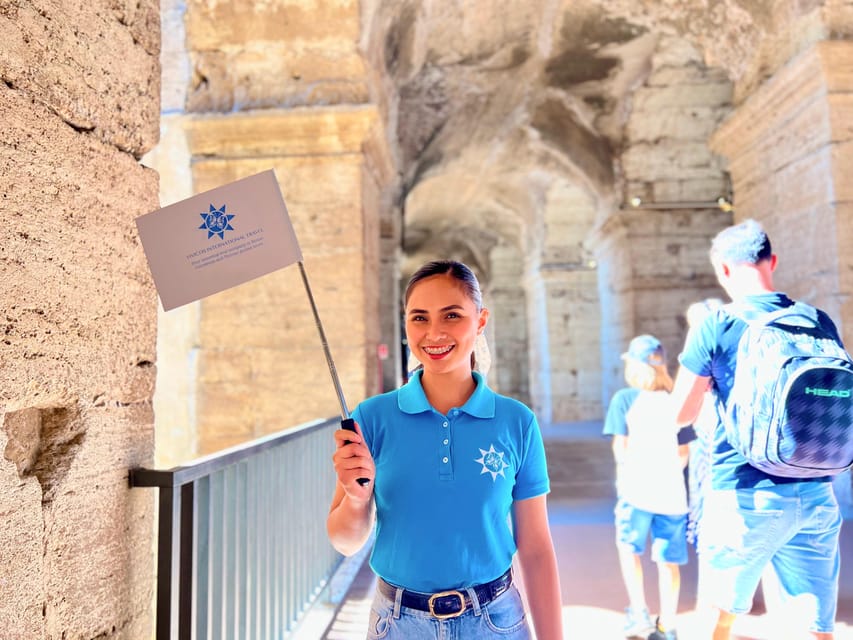
This is the part of Rome where a guide earns the money, and it is worth saying why: the Colosseum largely explains itself, and the Forum does not. In our Colosseum and ancient Rome listings a licensed guide across all three sites starts at €18, and the three most-reviewed sit between €39 and €50. The best-reviewed of them costs €49, is rated 4.8 across more than 90,000 reviews and is listed at two and a half hours; for the other two the stated duration runs from one hour to two and a half — a figure worth a look before booking, because it doubles between tours with near-identical names.
Two cautions. A standard guided tour follows the standard ticket, so it will not take you into the SUPER interiors unless the listing names them — check for the Curia, Santa Maria Antiqua or the houses by name, not for the word “SUPER”. And the group ceiling is 25 people including the guide, with a radio whisper system that the park’s visitor regulation requires from nine people including the guide; how the audio reaches you is worth settling before you book a big group.
For the rest of the city beyond the ancient centre, the underground sites pick up where the Palatine leaves off, walking tours cover the streets between the monuments, and the priorities overview sets all of it against the Vatican for the days you actually have.